The VPM Works View: Architecture, Not Documents
For decades, project tools have treated the plan as a document: a file you open, edit, share, and hope everyone is reading from the same version.
If you are looking for measured outcome evidence, see Proof VPM Works. This page explains the architecture choices that make those outcomes repeatable.
Microsoft Project is a document. A Smartsheet Gantt is a document. Many modern cloud tools are still shared documents with better-looking pages.
That model breaks down at scale.
- A CEO opens the file and sees hundreds of rows that cannot be scanned quickly.
- A lab tech opens the same file and scrolls through strategic milestones to find one deliverable.
- A program manager watches the view collapse into dependency spaghetti as connections multiply.
Everyone is looking at "the same plan" through the wrong lens.
VPM Works starts from a different premise: the plan is not a document. It is an architecture.
The source of truth lives at the detailed execution layer, in real deliverables owned by real people. Everything above that - rollups, Gantt bars, Skyline, Fever Chart, status tiles - is drawn from that truth in real time.
Not a hand-built Monday status deck. Not manually rolled-up summaries. Live views of one underlying data system.
The Architecture Underneath
VPM Works uses a disciplined hierarchy:
- Gates (L1): strategic rhythm and business commitments.
- Tasks (L2): fixed time boxes owned by accountable leaders.
- Deliverables (L3+): nested execution detail inside each Task.
Dependencies follow the same discipline:
- At top level: Task-to-Task and Task-to-Gate.
- Inside a Task hierarchy: fully flexible.
- Across Task hierarchies at deliverable level: not allowed.
That containment rule is the secret sauce. It prevents cross-tree dependency tangles that make conventional large Gantt plans unreadable.
This is structural, not cosmetic. The top-level integrated view stays clean because only true coordination dependencies appear at that level.
For a concrete house-building example that compares "spaghetti Gantt", VPM mapping, and architected Gantt in one narrative, see VPM + Gantt Architecture.
Views That Meet Each Person Where They Are
Because the architecture is disciplined, each audience gets the right lens without data drift.
Task Detail: Functional Execution View
Teams work in their own detail context: their Tasks, their deliverables, full execution depth.
- Software groups can run this as Kanban.
- Hardware groups can run this as WBS detail.
- Check-off happens here.
Task Flow: Cross-Functional Coordination View
Program integration reviews use L1/L2 flow.
- Clean handoff visibility across functions.
- No deliverable-level clutter.
- Clear coordination logic for program leadership.
Skyline: Weekly Load and Capacity View
Resource managers slice L3 deliverables by person and week.
- Who is overloaded.
- Who has slack.
- Which weeks are bottlenecks.
Same data, different lens.
Fever Chart: Executive Health View
Leadership sees fast signal:
- Green: accountable Task contracts are holding.
- Yellow: overhang exists but acknowledged and managed.
- Red: broken condition without sufficient triage.
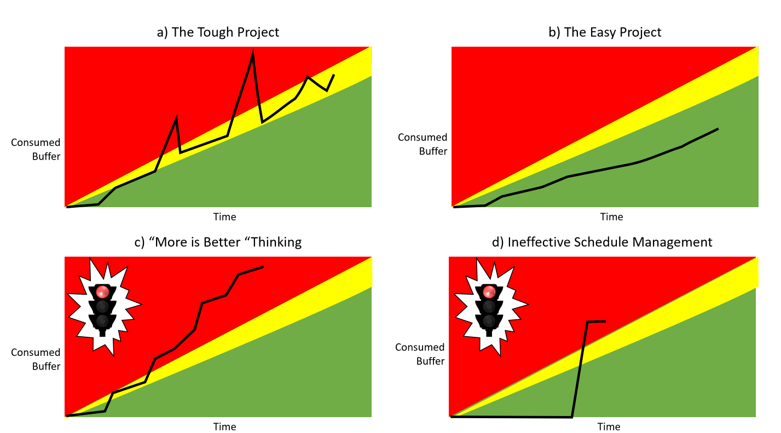
Then drill down from a red tile to the exact underlying deliverable causing it.
The chain stays intact from boardroom to bench: a red executive tile can trace directly to a specific working artifact, such as DR prep on a sensor validation test.
Why Nothing Else Does This
Many tools offer dashboards. Most dashboards are summary layers detached from execution detail.
VPM Works is different: every view is the same underlying data at a different distance.
- The lab tech check-off updates executive health.
- Executive concern traces back to a specific deliverable.
- Rollup is continuous and automatic.
There is no weekly status reconciliation ceremony and no "which version are you looking at?" argument. There is one living data system with many synchronized views.
There is no separate "roll-up meeting" because roll-up is continuous. There is no status rewrite into PowerPoint because status is generated from execution truth.
That is the inversion:
- Traditional tools force one shared view and everyone compromises.
- VPM Works gives each role the right view while keeping all roles aligned.
That is why this method scales. It starts with architecture.
Related: Project Scoreboard Beats a Newscast — the behavioral side of this idea: a plan the team answers, not one they only read.