Theory of Operation
VPM Works is built on a simple operating belief: projects deliver reliably when cross-functional teams are aligned on who owes what to whom, by when, and under what quality constraints.
If you are evaluating whether VPM works in practice, start with Proof VPM Works. That page focuses on outcome proof; this page focuses on operating mechanics.
This page defines how that belief becomes daily execution behavior.
Related: Project Scoreboard Beats a Newscast — the five moves that turn a plan from a newscast into a scoreboard.
Core Problem VPM Solves
Most late projects are not caused by a lack of effort. They are caused by broken coordination:
- Handoffs are unclear. Teams often transfer work that is only partially ready, or transfer to a different acceptance standard than the receiver expects. Misalignment like "desktop-ready" versus "lab-ready" turns handoff into hidden rework and schedule slip.
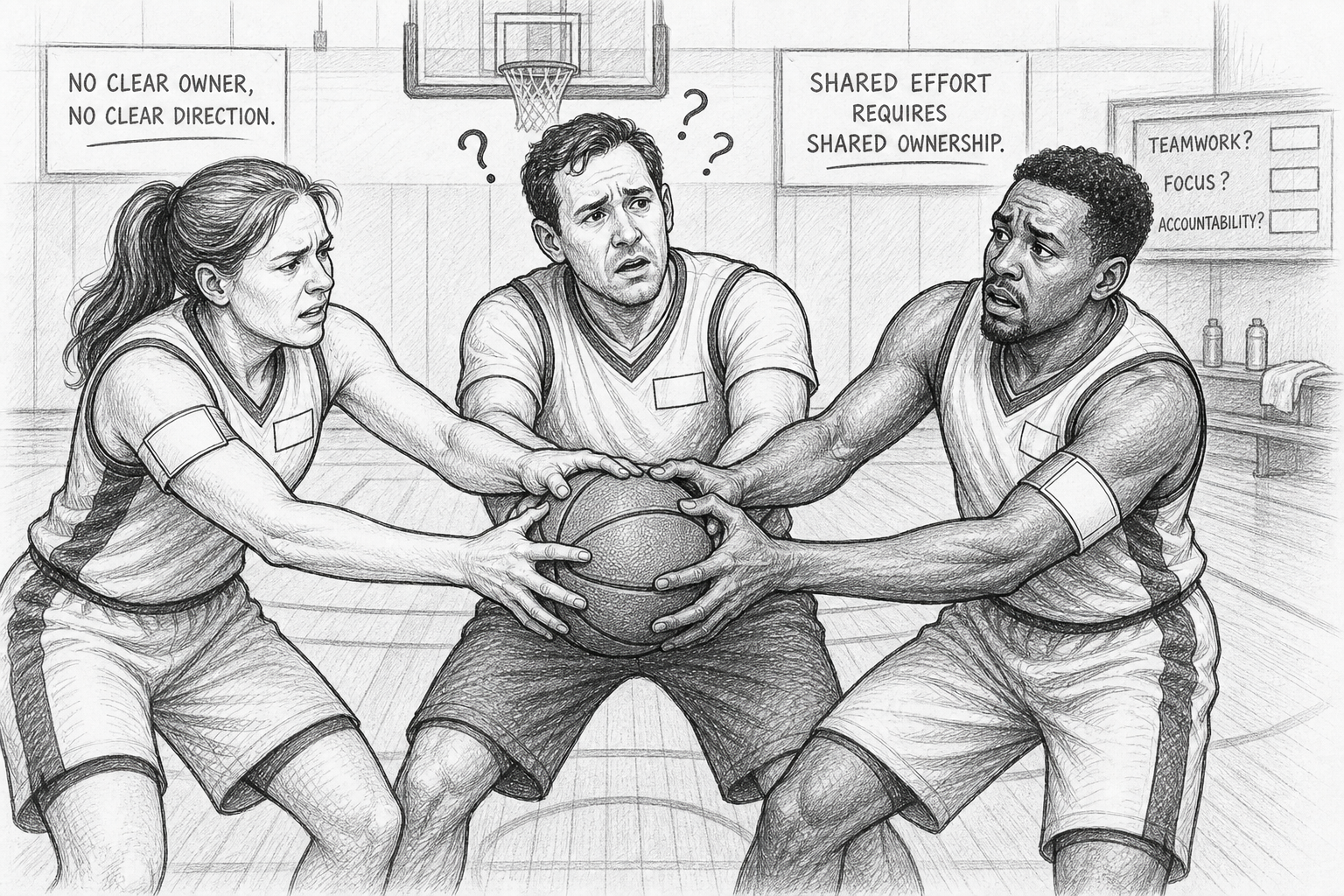
- Owners are ambiguous. When accountability is diffuse, hard work is deferred and decisions stall. VPM uses RACI discipline so many people can contribute, but exactly one person is Accountable for each committed deliverable.
- Status views disagree. Parallel plans, disconnected dashboards, and separate resource systems create conflicting signals at the same moment. Without one shared source of truth, teams gravitate to the most comfortable indicator and ignore the one demanding Stop-Fix action.
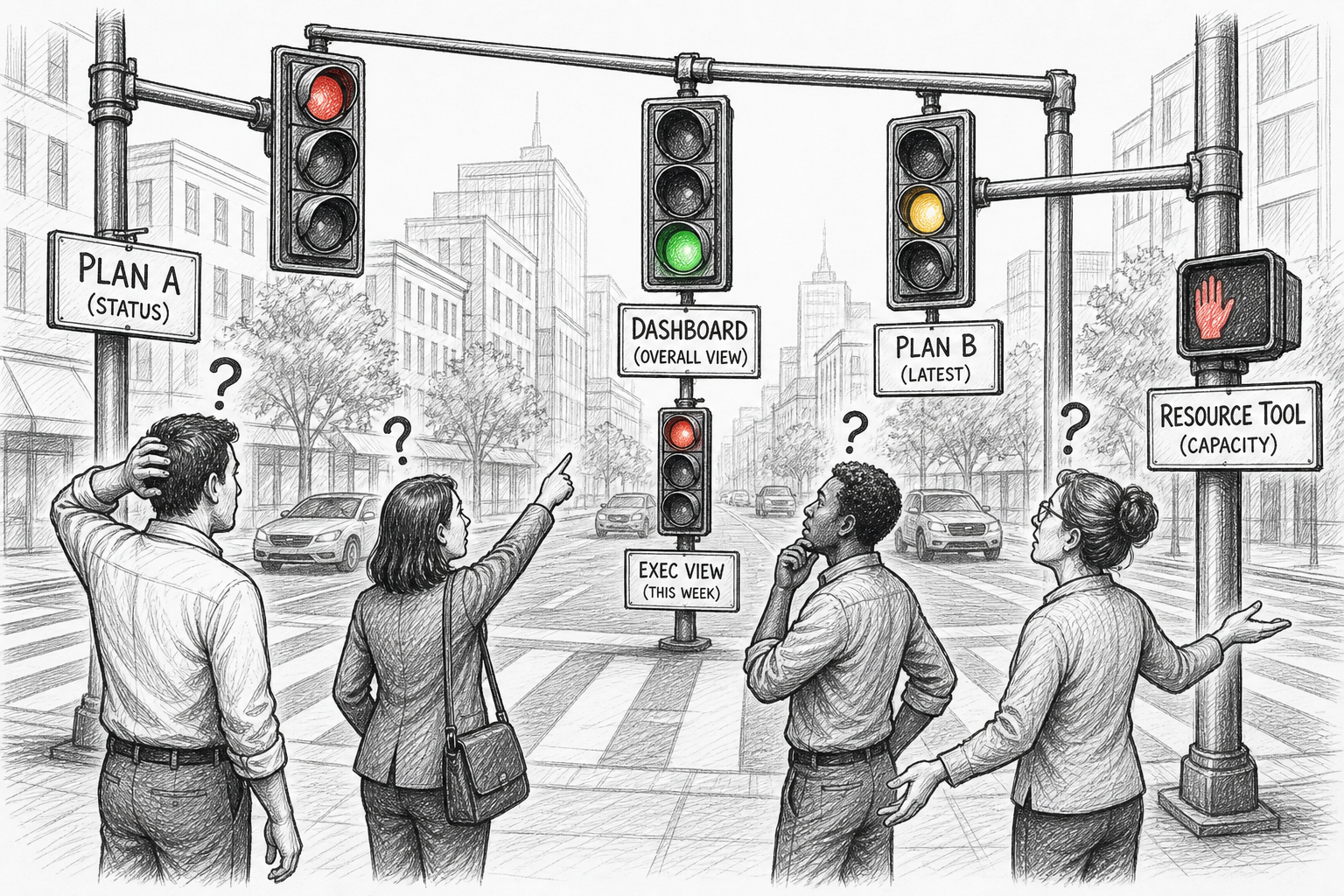
- Delays are confronted too late. Teams frequently see risk locally before leadership sees it globally, but behavior does not change quickly enough. The issue is not visibility alone; the issue is whether the system forces timely confrontation and response.
VPM treats this as a system-design problem, not an individual-performance problem.
Core Mechanism
VPM combines three mechanisms in one operating system:
- A shared visual plan that makes cross-functional flow and ownership explicit.
- A recurring management drill that forces frequent reality checks.
- A rapid response model (Stop-Fix and plays) when schedule health degrades.
Together, these mechanisms create early visibility and faster correction.
The Unit of Control: Cross-Functional Handoffs
Traditional plans often optimize inside functions. VPM optimizes at function boundaries.
Why this matters:
- Most costly delay is introduced at cross-functional handoffs. Intra-functional transfers are usually faster because people share context, tools, and workflow norms. Cross-functional transitions (for example, SQA to Lab Tech) carry higher risk because assumptions, readiness criteria, and timing expectations are often not aligned.
- Handoff ambiguity multiplies rework and waiting. A sender may believe a package is complete while the receiver sees critical gaps and delays acceptance until later, after downstream plans have already moved. That mismatch silently burns schedule and creates avoidable churn.
- Clear predecessor/successor relationships make risk visible early. When teams explicitly define who is handing off, what �ready� means, and who must accept, weak signals surface before they become phase-level delay. This turns coordination from informal hope into an inspectable operating contract.
In VPM, the handoff is the operational unit that the team manages continuously.

Visual Architecture
The VPM visual model is designed for shared comprehension, not report aesthetics.
Required properties:
- One visible plan for all core contributors.
- Explicit lane ownership.
- Time on the horizontal axis.
- High-density view of dependencies and timing stress.
A valid VPM board should let a new observer answer quickly:
- What is on critical flow now?
- Which handoffs are at risk?
- Where is schedule protection being consumed?
Decision Architecture: One Source of Truth
A central principle in VPM is one operational truth. Teams should not be reconciling conflicting status systems during execution.
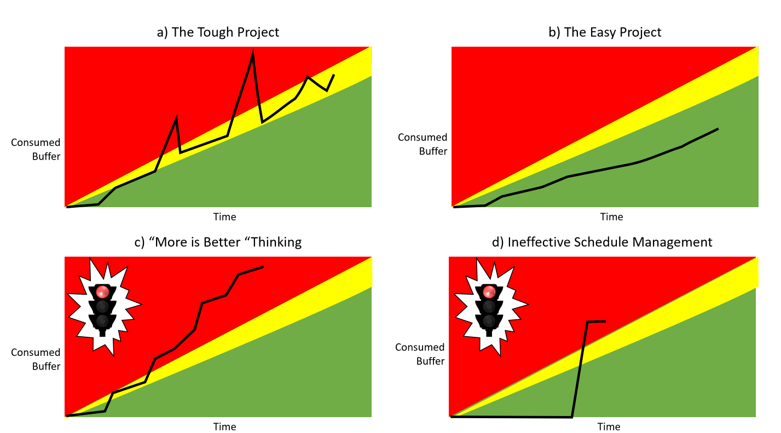
The working board (and in buffered mode, its fever-chart state) is the authority for schedule health. This sharply reduces information friction and improves escalation quality.
Execution Modes
VPM supports two valid execution modes:
- Unbuffered mode: teams react when a project activity is already late against its date. This is simpler and intuitive, but it effectively runs on two states only: on-time or late. Teams can oscillate in and out of lateness, and because the signal is lagging, corrective action often starts after schedule damage is already visible.
- Pros: simple, intuitive.
- Cons: requires high-frequency reaction; lagging signal reduces recovery effectiveness and can leave teams in sustained red conditions.
- Buffered mode: teams react to buffer burn as a leading indicator of late risk. The schedule is intentionally overcompressed (often around 25%) to create explicit recovery capacity at the end rather than adding extra time. When modest delays occur, teams can spend buffer deliberately and track burn rate, which smooths day-to-day response and improves recovery timing.
- Pros: leading indicator drives earlier action; smoother response to small delays.
- Cons: more complex operating model; counterintuitive at first because interim dates are tighter and buffer adds another management layer.
Mode selection is situational and depends on project complexity, delay dynamics, and team readiness.
For full buffered foundations, see Buffer Methodology.
Stop-Fix Logic
Stop-Fix is VPM's immediate response discipline for schedule-health failure conditions. When agreed alarm thresholds are crossed, the team does not continue normal execution and hope for recovery. It responds immediately with explicit plays to restore credible delivery conditions.
For the full model, including Lean lineage, trigger design, red/yellow/green semantics, cadence, playbook structure, triage behavior, and implementation guidance, see Lean Thinking.
Role Architecture
VPM distributes accountability clearly:
- Project manager: orchestrates cross-functional execution, maintains operating cadence, and protects commitment integrity when competing priorities emerge.
- Swim-lane owners: hold explicit accountability for lane-level commitments, handoff readiness, and rapid corrective action when flow degrades.
- Support contributors: provide technical depth and specialist execution while aligning to lane commitments and acceptance standards.
- Leadership: resolves tradeoffs quickly, removes structural blockers, and reinforces Stop-Fix discipline when warning signals escalate.
This architecture reduces hero-dependence and improves repeatability.

Cadence Architecture
VPM execution runs on repeated short cycles:
- Planning cycle: build and align the integrated plan.
- Daily/weekly management cycle: update true progress, test health, and decide actions.
- Escalation cycle: apply plays when thresholds are crossed.
- Learning cycle: capture delay patterns and improve future planning.
Cadence is a structural control, not a meeting preference.
Why the Model Works
VPM effectiveness is not explained by any single tool in isolation. It comes from four effects that reinforce each other in a compounding loop:
-
Earlier risk detection through shared visual controls.
VPM makes schedule slip visually obvious by separating progress position from current-date position on a shared timeline. Even small lag is visible quickly, including to occasional observers. That reduces the latency window in which projects are drifting but no one has acknowledged the risk. Compared with dense Gantt views, text-heavy action plans, or local-only sprint views, VPM exposes cross-functional timing stress much earlier. -
Faster intervention through explicit Stop-Fix behavior.
VPM stand-ups are not reporting rituals. They are operating drills with explicit Stop-Fix behavior. The team surfaces the issue, quantifies impact in time, assigns ownership, and executes corrective action immediately. Structured stand-up flow (including the six-step routine used in VPM practice) shortens time-to-correct and limits schedule-damage propagation. -
Better coordination through handoff-centered planning.
VPM removes cross-functional clutter by showing accountable handoffs and deliverables in the shared view, not every internal subtask. This improves system-level coordination because interface commitments are explicit, visible, and repeatedly tested in cadence. Teams still manage in-function detail with their preferred methods, but cross-team flow stays clear. -
Stronger learning through visible history and repeated pattern recognition.
VPM produces a readable operational history, especially through fever-chart behavior over time. Teams and leaders can quickly recognize recurring anti-behaviors (late escalation, optimistic forecasts, weak handoff discipline, delayed recovery moves) and counter them earlier in later cycles. This turns improvement from one-off heroics into repeatable team capability.
These effects compound: earlier detection enables faster intervention; faster intervention stabilizes handoffs; better handoffs create cleaner execution history; cleaner history improves pattern recognition and earlier detection in the next cycle.
Typical Failure Modes When Misapplied
The method degrades when teams:
- Maintain the board as reporting output instead of operating workspace. In this failure mode, updates are optimized for optics and meeting decks rather than for exposing risk and driving corrective action. The board looks current, but it no longer governs behavior.
- Delay red-state response. Teams acknowledge warning signals, but continue routine execution while hoping conditions self-correct. That delay compounds downstream damage and converts recoverable variance into structural lateness.
- Allow mixed-truth status systems. Different audiences use different sources for schedule health, so escalation triggers are contested instead of acted on. Once teams can choose which status to believe, Stop-Fix discipline collapses.
- Run standups without real decisions. Meetings become narrative check-ins where issues are described but ownership, action, and due-date commitments are not set. Cadence remains visible, but control authority disappears.
- Treat visuals as templates rather than control logic. Teams copy board formats without enforcing the underlying rules for handoffs, accountability, and alarm thresholds. The result is visual compliance without operational improvement.
Relationship to Other Methods
VPM is not a replacement for all local discipline methods.
- Agile can manage internal software execution.
- Domain tools can manage technical depth inside functions.
- VPM manages cross-functional coordination and schedule integrity across the whole project.
In that sense, VPM is the coordination layer that integrates specialized local systems into one delivery system.
Practical Adoption Sequence
Full-org, all-at-once process rollouts are high risk. A small defect in method design, tooling, or leadership behavior can be corrected quickly on one project, but the same defect replicated across ten projects creates avoidable schedule and morale damage.
Worse, if teams experience disruption from a new system that is not yet stable, they often conclude "this does not work here." VPM adoption therefore starts with a low-risk lighthouse approach: prove the method on one meaningful project, expose issues early, train leaders in live conditions, and then scale without creating chaos.
- Pilot one meaningful cross-functional lighthouse project. Choose a project large enough to expose real handoff, ownership, and escalation pressure. The pilot should be operationally relevant, not a low-stakes sandbox.
- Standardize visual conventions and standup behavior. Lock the board language, ownership rules, update rhythm, and escalation triggers so teams are running one method rather than local variants.
- Train leaders in Stop-Fix and playbook response. Build intervention muscle before broad rollout. Leaders need to respond consistently when signals degrade, not debate procedure in the middle of execution stress.
- Add buffered controls where delay dynamics justify it. Introduce buffer discipline where projects have meaningful uncertainty and delay coupling. This should be explicit and measured, not informal schedule padding.
- Scale with portfolio-level pattern review. After pilot proof, expand in waves and review cross-project patterns so adoption quality improves with scale instead of degrading.

See Also
- Architecture, Not Documents
- Buffer Methodology
- Lean Thinking
- [VPM Stand-Up Meet