The Vacation Test
Once a year you get to run the most honest experiment available to a manager. You leave for a week, and the system runs without its most expensive variable: you. What happens while you're gone tells you more about the process you built than any status report can.
Most managers ruin the experiment before it starts. They brief everyone twice, leave the laptop on "just in case," and promise to check in each morning. That instinct feels responsible. It isn't. Every check-in is a thumb on the scale. It props up the result and erases the measurement at the same time.
Two jobs hide inside "being a good manager"
Taiichi Ohno put the distinction in one sentence: "Let the flow manage the processes, and not let management manage the flow."
Managing the flow is you, personally, moving work along. You approve, you nudge, you chase the stalled handoff, you make the call only you make. Take you out of the system and the work stalls. It feels like leadership, but it's you being the part the system can't run without.
Improving the process is building what moves work without you: clear handoffs with named owners, status everyone can see, decisions pushed down to the people doing the work. Take you out and it keeps running. Every time you call in from the beach, you switch back to managing the flow and put your thumb on the scale.
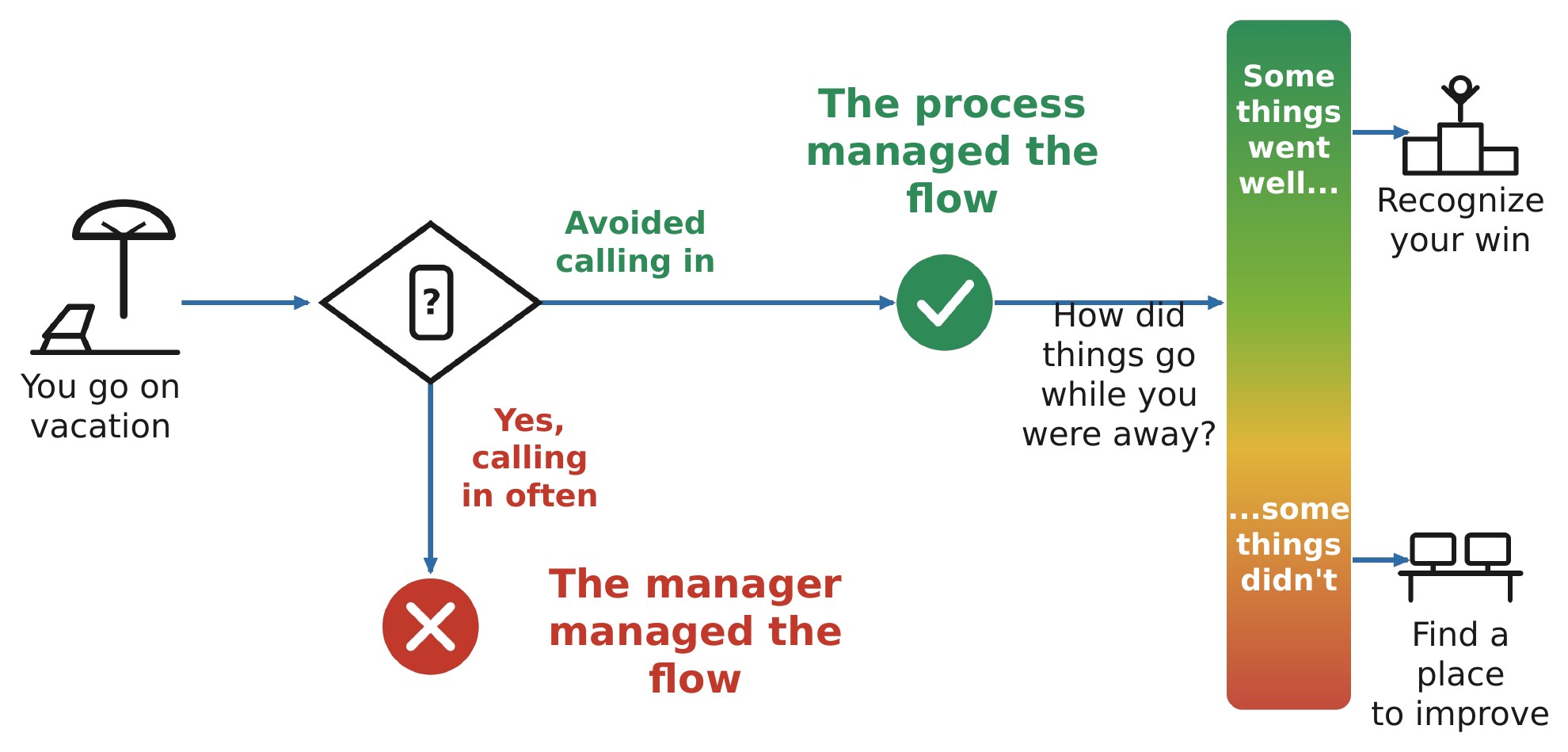
Run it clean
Give one person the keys and exactly one reason to use them: a real safety issue, or someone resigning. That is the whole break-glass rule, rare and deliberate, never casual. Everything else waits until you're back.
Then put the phone down. Not "check once at night." Down. If that makes you nervous, good. The nervousness is data. It points straight at the parts of the system that still depend on you.
Read the result, don't grade the team
Coming back to no fires doesn't prove the team needs you, and one thing slipping doesn't mean you can never leave again. You aren't grading the team. You're reading what the process did under load. Every place the system reached for you is a gap in the process, not a compliment to you.
Score the week with five questions. Each low score is a process to fix, not a reason to feel needed.
- Did the team hit its commitments without you?
- Were decisions made without waiting for you?
- Did problems get solved where they happened, or queue for your return?
- Did anything break that visible status or standard work would have caught?
- Did the break-glass line stay un-pulled?
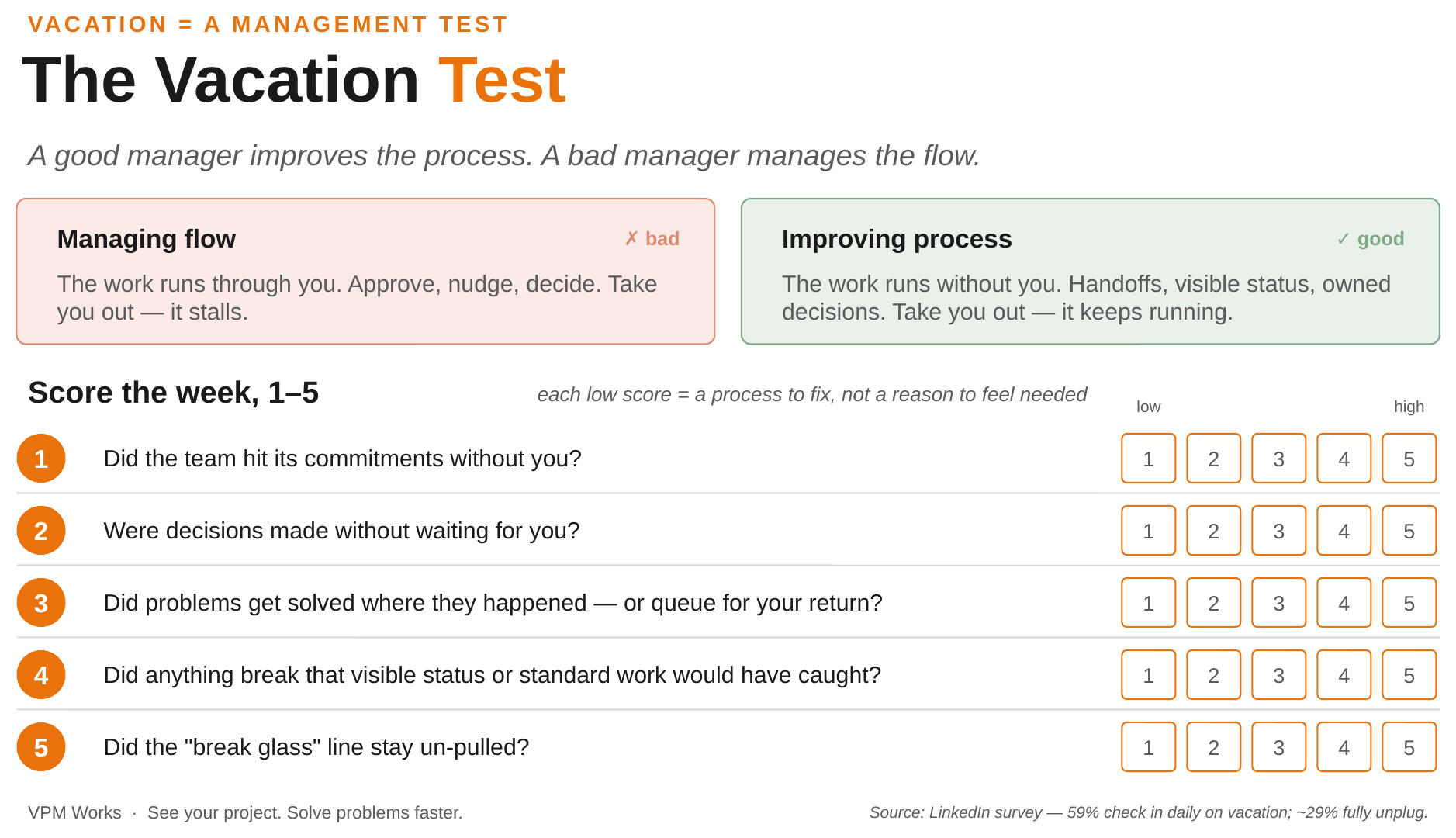
The output isn't pass or fail. It's a short, specific list of fixes, and each one makes next year's run come back stronger.
You aren't alone in finding this hard. In a LinkedIn survey on the question, 59% of managers said they check in daily on vacation and only about 29% fully unplug. The daily check-in is the default, which is exactly why the clean run is worth so much: almost no one actually measures what their process can do.
What you're actually learning
The trap is coming home having learned to manage the flow better next time: a tighter briefing, a smarter check-in cadence. That just makes you a more efficient bottleneck. The right lesson is how to improve the process so the flow manages itself.
This is the same shift collaborative planning sets up during ownership and accountability work, and the same one the standardized workflow is built to support. The strongest thing you can do as a leader is build something that runs well without you in the room. Your week off is the experiment that proves whether you have.